


-

Criminal Law: General part
Otajonov A.A., Salaev N.S.,This textbook provides a comprehensive analysis of the concepts, objectives, and principles of criminal law, including the legal grounds for criminal liability, the stages of intentional crimes, complicity, and the doctrine of multiple offenses. Furthermore, it examines circumstances precluding criminal liability, the theory of punishment and its judicial sentencing, procedures for release from liability and punishment, the nuances of juvenile justice, and the application of compulsory medical measures. The textbook is designed for legal scholars, law enforcement professionals, academic faculty, doctoral candidates, independent researchers, and students at higher legal educational institutions. This textbook is recommended for publication based on the order of the Rector of Tashkent State University of Law No. 177-um dated August 18, 2025, (registration number-177-59).
-
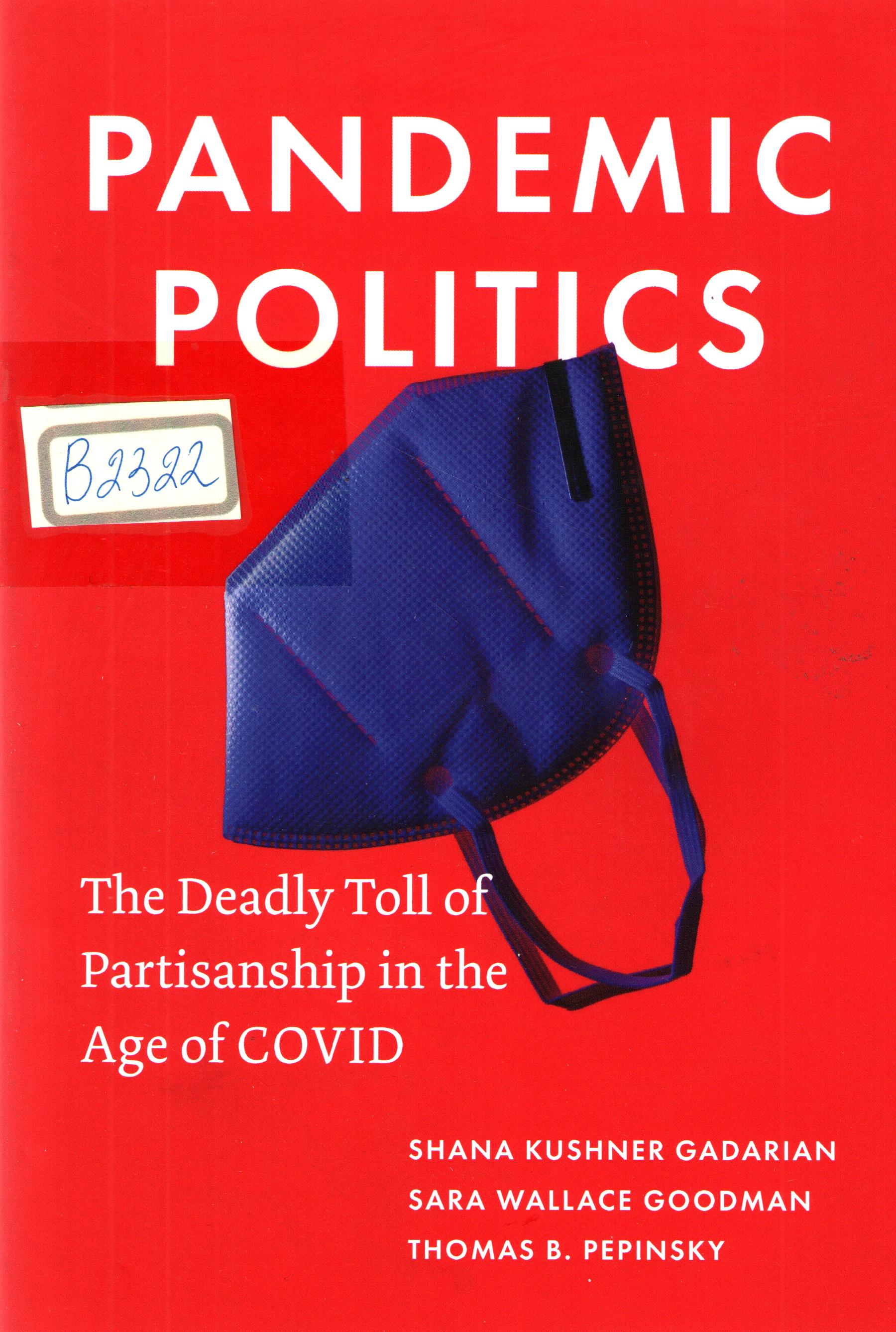
Pandemic politics the deadly toll of partisanship in the age of COVID
Gadarian Sh.K.,PRAISE FOR PANDEMIC POLITCS "In elegant and accessible prose, Pandemic Politics delivers a sobering message. Relying on an impressive six-wave panel study, the authors convincingly show that polarized politics crippled the American response to the COVID-19 pandemic. Anyone interested in understanding our flawed response to this health crisis should read this important book." VINCENT L. HUTCHINGS, University of Michigan "In the future, when people are aiming to identify an objective source for what occurred during the COVID-19 pandemic, Pandemic Politics should be at the top of the reading list. This book uses panel survey data to assess attitudes from a diverse group of Americans, often comparing outcomes to other countries. Importantly, this book not only grapples with COVID-19, but the multiple pandemics of systemic racism, police brutality, and political polarization."
-
Economic statecraft
Baldwin D.A.,A NEW EDITION OF THE CLASSIC WORK ON THE ECONOMIC TOOLS OF FOREIGN POLICY Economic Statecraft is a landmark work that has fundamentally redefined how nations evalu- ate crucial choices of war and peace. Now with a substantial new preface by the author and an afterword by esteemed foreign-policy expert Ethan Kapstein, this new edition introduces today's generation of readers to the principles and applications of economic statecraft. "Economic Statecraft remains our field's definitive work on the use of economic measures to achieve foreign-policy objectives. Generations of students and scholars have been and will continue to be inspired by Baldwin's conceptual insight, logical clarity, and refreshingly straight- forward writing style. This is a true classic of international relations." -MICHAEL MASTANDUNO, Dartmouth College.
-
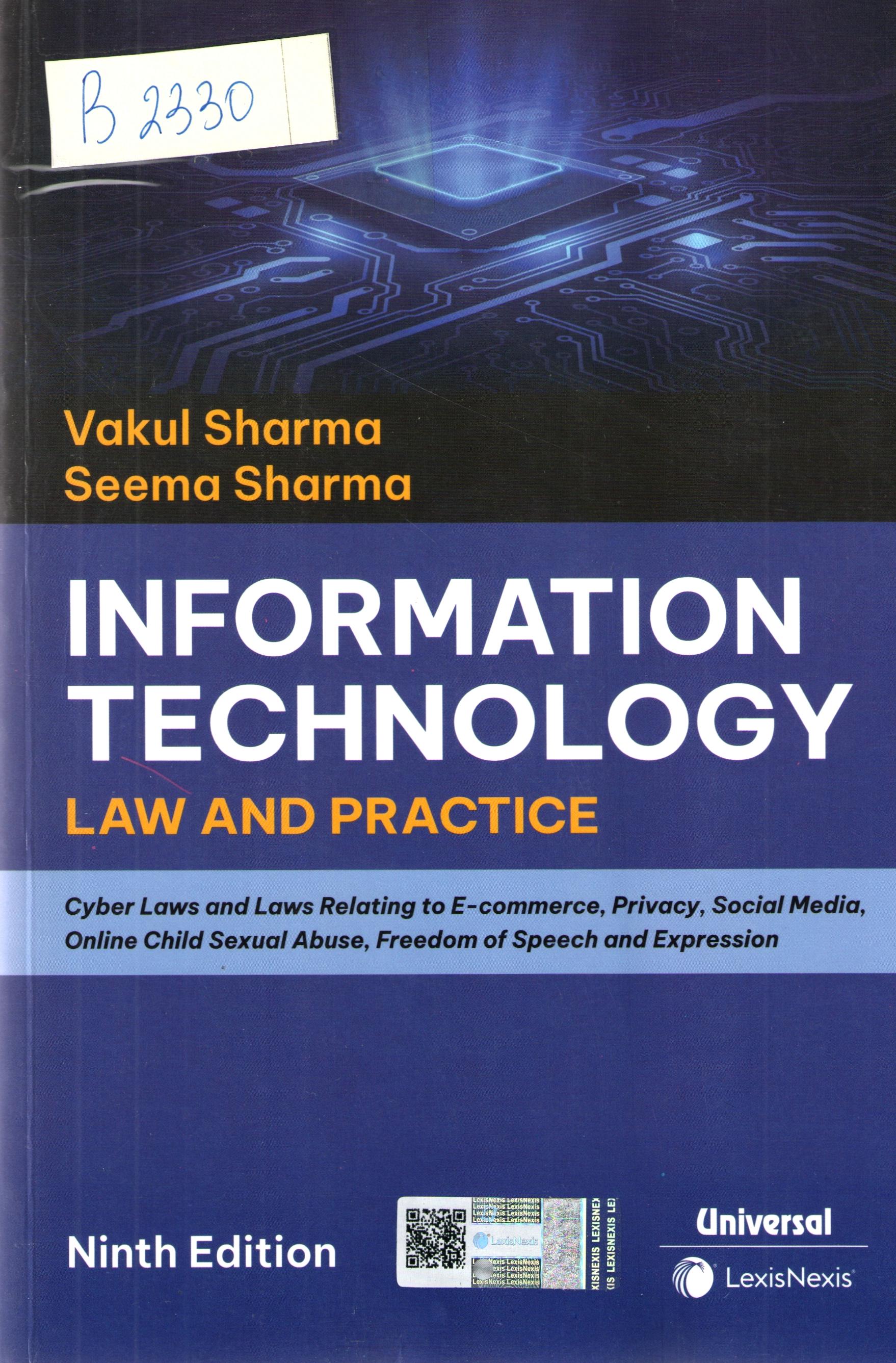
Information technology law and practice
Sharma V.,Due care has been taken while editing and printing this book. Neither the author nor the publisher of the book hold any responsibility for any mistake that may have inadvertently crept in. The publisher has taken all care and effort to ensure that the legislative provisions reproduced here are accurate and up to date. However, the publisher takes no responsibility for any inaccuracy or omission contained herein for advice, action or inaction based hereupon. Reference must be made to the Official Gazette issued by the Government of India for the authoritative text of any Act, Rule, Regulation, Notification or Order. The publisher shall not be liable for any direct, consequential, or incidental damages arising out of the use of this book. In case of binding mistake, misprints, or missing pages etc., the publisher's entire liability, and your exclusive remedy, is replacement of this book within one month of purchase by similar edition/reprint of the book. Printed and bound in India.
-

Law on information technology
Chatterjee Dr. I.,Although every care has been taken in publication of this book, the publisher and all their associates do not owe any responsibility for any damage or loss to any person on account of errors or omissions that might have crept in. The publisher will be obliged if mistakes are brought to their notice for carrying out correction in next edition. All rights reserved. No part of this work may be copied, reproduced, adopted, abridged or translated, stored in any retrieval system, computer system, photographic or other system transmitted in any form by any means whether electronic, mechanical, digital, photographic or otherwise, without a prior written permission of publishers.
-

Understanding international criminal law
Podgor E.S.,This Understanding treatise is divided into four parts: The first part of Understanding International Criminal Law provides a general overview of international criminal law, including the sources of such law, important international criminal law doctrines and concepts, definitions of key terms that appear throughout the book, and various principles of jurisdiction that form the basis for the application of domestic and international law. The second part of the book focuses on a crafted selection of areas of international criminal law. While not exhaustive, the authors have provided explanation and analysis of crimes that cover a wide array of topics that will introduce the reader to many of the most important, timely, and developing areas of international criminal law. The selected topics include developing areas such as computer and internet crimes and human trafficking, and older, more traditional areas such as piracy, narcotics trafficking, and terrorism. The book provides materials on both violent and non- violent crimes. The third part of Understanding International Criminal Law covers procedural issues. This portion of the book considers the extraterritorial application of the U.S. Constitution, including the 4th, 5th, and 6th Amendments, immunities from jurisdiction, international evidence gathering procedures, obtaining people from abroad, including through abduction, and post-conviction issues such as prisoner transfer. The final part of this treatise introduces the reader to the four crimes of most concern to the international community-Aggression, Genocide, Crimes Against Humanity, and War Crimes. The book also examines the various courts and mechanisms used to bring those accused of these atrocities to justice, beginning with the Nuremberg and Tokyo precedents. Examination of these early forms of international tribunal are followed by materials examining more recent courts and mechanisms, including the International Criminal Court, Ad Hoc tribunals, hybrid tribunals and other creative variations. This book provides detailed summaries of areas of significance in international criminal law and is a wonderful resource for students studying in this area, practitioners interested in learning more about the field in general or interested in delving more deeply into a particular issue, and casual readers desiring an introduction to this fascinating and developing area of law.
-

Security in the Cyber age
Reveron D.S.,Cyberspace is essential for socializing, learning, shopping, and just about everything in modern life. Despite the importance of cyberspace, there is also a dark side where subnational, transnational, and international actors are challenging the ability of sovereign governments to provide a secure environment for their citizens. Criminal groups hold businesses and local governments hostage through ransomware, foreign intelligence services steal intellectual property and conduct influence operations, governments attempt to rewrite Internet Protocols to facilitate censorship, and militaries prepare to use cyberspace operations in wars. Security in the Cyber Age breaks down how cyberspace works, analyzes how state and nonstate actors exploit vulnerabilities in cyberspace, and provides ways to improve cybersecurity. Written by a computer scientist and a national security scholar-practitioner, the book offers technological, policy, and ethical ways to protect cyberspace. Its interdisciplinary approach and engaging style make the book accessible to the lay audience as well as computer science and political science students.
-

The Cambridge Handbook of Comparative law
Comparative law is a common subject-matter of research and teaching in many universities around the world, and the twenty-first century has aptly been termed 'the era of comparative law'. It is thus topical to publish this Cambridge Handbook of Comparative Law which seeks to present a truly global perspective of comparative law today. The contributors are drawn from all parts of the world to provide different perspectives on key topics of comparative law. In total, this handbook contains 36 chapters which are divided under the following main parts: 'Methods of Comparative Law', 'Legal Families and Geographical Comparisons', 'Central Themes in Comparative Law', and 'Comparative Law Beyond the State'. MATHIAS SIEMS is a Professor at the European University Institute (EUI) in Florence, Italy. He previously taught at Durham University, the University of Edinburgh and the Riga Graduate School of Law. He was also a Fulbright Scholar at Harvard Law School and a Jean Monnet Fellow at the EUL PO JEN YAP is a Professor at The University of Hong Kong (HKU). He graduated from the National University of Singapore with an LLB degree and he obtained LLM qualifications from both Harvard Law School and University College London. He graduated with a PhD degree from the University of Cambridge.
-

Information technology law
In spite of our best care and caution, errors and omissions may creep in, for which our patrons will please bear with us and any discrepancy noticed may kindly be brought to our knowledge so that it is taken care of in the next Edition, which will improve our service. Further it is to be noted that the publication is sold with the understanding that Authors/Editors/Printers and Publishers are not responsible for any damage or loss accruing to any body.
-

Artificial intelligence and legal innovations
Chatterjee I.,All rights reserved. No part of this book may be reproduced, stored in an information retrieval system or transcribed in any form or by any means electronic, digital, mechanical, photocopying, recording or otherwise without the express written permission of the publisher and the holder of copyright. Although every care has been taken in publishing the book, the author, publisher, and printer shall not be responsible for any loss or damage caused to any person on account of errors or omissions which might have crept in. The publisher shall be obliged if mistakes are brought to their notice for carrying out corrections in the next edition. Submit all inquiries and requests to the publisher: SATYAM LAW INTERNATIONAL, NEW DELHI, INDIA.
-

International environmental law
[],The book covers all major environmental agreements, paying particular attention to their underlying structure, main legal provisions and practical operation. It blends legal and policy analysis, making extensive reference to the jurisprudence and scholarship, and addressing the interconnections with other areas of international law, including human rights, humanitarian law, trade and foreign investment. The material is structured into four sections - foundations, substantive regulation, implementation, and influence on other areas of international law - which help the reader to navigate the different areas of international environmental law. Each chapter includes charts summarising the main components of the relevant legal frameworks and provides a detailed bibliography. Suitable for practising and academic international lawyers who want an accessible, up-to-date introduction to contemporary international environmental law, as well as non-lawyers seeking a concise and clear understanding of the subject.
-
-