


-

Law for Leviathan; Constitutional Law, International Law, and the State
Levinson D.J.,For the past several centuries of Anglo-American legal thought, law has been paradig- matically understood as the product of the state. The state, operating through the legal and political institutions of its government, imposes law on the people who are its subjects. Over the same centuries, however, the development of international law and constitutional law has made the state itself subject to law. These systems of law for states necessarily work differently. For one thing, law for states must do without a super-state or government standing above the state, capable of creating and enforcing law. For another, the state is a unique kind of legal subject, calling for different behavioral models, moral standards, and regulatory techniques than those developed for ordinary people. It is precisely these differences that have long marked international law as a curious, and in many eyes dubious, form of law. Constitutional law, in contrast, has seldom been subject to the same doubts, or fully under- stood as different in kind from legal systems run by and through the state. As a result, constitutionalists have lagged their internationalist counterparts in coming to grips with the common project of making the state the subject rather than the source of law. By assimilating constitutional and international law as parallel projects of imposing law upon the state, and by highlighting the peculiarities of the state as a subject of law, this book aspires to close that gap, and to bring focus to Law for Leviathan as a distinctive legal form.
-

O’Sullivan & Hilliard’s The Law of Contract 11th ed.
O’Sullivan J.,The preface to the first edition of this book explained that its aim was to give students as sound an understanding of the basics of contract law as possible and, equally impor tantly, of why the law is the way it is, in order that they might not only understand the current state of the law but be stimulated to form their own views on whether it is jus- tifiable. With that in mind, we made two choices when writing the first edition. These were, first, that the book would focus both on the fundamentals of contract law and the rationales underlying them; second, that where the law was controversial in some respect, we attempted to set out in detail our opinions, and the opinions of others, on whether the rule in question is correct. This structure seems to have worked well and has been preserved in this latest edition.
-

Occupation in International Law
Lieblich E., Benvenisti E.,Elements of International Law represents a fresh approach in the literature of international law. It is a long series of short books. Elements adopts an objective approach to its subject matter, focusing on narrowly defined core topics in international law. Eventually, the series will offer a comprehensive treatment of the whole of the field. In this volume, Eliav Lieblich and Eyal Benvenisti explore the framework and dilemmas of the international law on occupation.
-

Discrimination Law 3rd ed.
Fredman S.,This book is a challenging, thought-provoking yet highly accessible introduction to discrimination law. It takes a thematic approach, illuminating the major issues in discrimination law, while imparting an in-depth understanding of the strengths and weaknesses of legal responses to complex social problems of inequality. This is enhanced by the comparative approach. By considering equality law in the UK, US, India, Canada, and South Africa, as well as the European Union and under the European Convention on Human Rights, the book exposes common problems across different jurisdictions and canvasses a variety of differing solutions. The book locates discrimination law within its historical and social context. One of its major strengths is the development of an analytic framework of substantive equality which draws on a range of sources. As well as chapters charting the social challenges and legal responses, the book compares the ways in which different jurisdictions formulate grounds of discrimination or protected characteristics; the meaning of key concepts such as direct discrimination (disparate treatment); indirect discrimination (disparate impact); and when limitations on equality are legitimate.
-

Principles of International Investment Law 3rd ed.
Dolzer R., Kriebaum U., Schreuer Ch.,This book outlines the principles behind the international law of foreign investment, focusing on the law governed by bilateral and multilateral investment treaties. The book traces the purpose, context, and evolution of the clauses and provisions characteristic of contemporary investment treaties, and analyses the case law, interpreting the issues raised by standard clauses. Particular consideration is given to broad treaty rules whose understanding in practice has mainly been shaped by their interpretation and application by international tribunals. In addition, the book introduces the dispute settlement mechanisms for enforcing investment law, outlining the operation of investor versus State arbitration. The third edition of this authoritative work has been fully updated to reflect the evolution of treaty practice, jurisprudence, and doctrinal opinion, covering new treaties such as the CPTPP, USMCA, and CETA. Combining a systematic analytical study of the texts and principles underlying investment law with a jurisprudential analysis of the case law arising in international tribunals, this book offers an ideal introduction to the principles of international investment law and arbitration for students and practitioners alike.
-

Tomorrow's Lawyers: An Introduction to Your Future
Susskind R.,For Richard Susskind, the future of legal service is neither Grisham nor Suits. Instead, he predicts a world of online courts, Al-based global legal businesses, liberalized markets, commoditization and alternative sourcing, disruptive start-ups, legal training in virtual reality, and a new range of law jobs. This book is a definitive and updated introduction to this futurenot just for aspiring lawyers but for anyone who wants to modernize and upgrade our legal and justice systems. It offers practical guidance on building careers and businesses in law in the 2020s and beyond.
-

Theory of evidence
Davronov A., Uzbekova D.,This monograph comprehensively examines the theoretical, methodological, and applied foundations of evidence and proof in criminal proceedings. It analyzes the concept, nature, and classification of evidence, as well as issues of its collection, verification, and evaluation, taking into account modern digital technologies and current law enforcement practice. Particular attention is paid to comparative legal aspects, international experience, issues of presumption, prejudice, and ethical standards of evidence. This monograph is intended for a wide range of readers: researchers, law school professors, doctoral students, master's students, and undergraduate students studying criminal procedure and evidence theory. It is also of practical interest to judges, prosecutors, investigators, defense attorneys, and other law enforcement officials directly involved in proving evidence in criminal cases.
-

Comparative linguistic analysis of most common used legal terms in newspapers
Usmonova O. R.,Ushbu monografiyada ingliz va oʻzbek tillaridagi ko'p uchraydigan yuridik terminlarning matbuot matnlarida qo'llanishi qiyosiy-lingvistik jihatdan o'rganilgan. Unda terminlarning strukturaviy, semantik va pragmatik xususiyatlari, ommaviy axborot vositalarida soddalashtirilishi hamda kontekstga moslashuvi tahlil qilingan. Ingliz, o'zbek va rus olimlarining nazariy qarashlari asosida yuridik tilning matbuotdagi ishlatilishiga yondashilgan. Monografiya huquqiy lingvistika, tarjimashunoslik va yuridik jurnalistika sohalarida tahsil olayotgan talabalar va olimlar uchun foydalidir. Mazkur monografiya Toshkent davlat yuridik universiteti Tadqiqot kengashining 2025-yil "20" iyundagi 8-sonli qaroriga asosan nashr etishga ruxsat berilgan.
-

Challenges in Regulating Autonomous Cybercrime Systems
AllahRakha N.,The monograph "Challenges in Regulating Autonomous Cybercrime Systems" explores the difficulties in creating laws and rules to control cybercrime systems that operate independently. It discusses the complex issues regulators face in managing these advanced, self-operating technologies that can commit or enable cybercrimes.
-
-

Ensuring the rights and oblige-tions of investors in international law: current prob-lems and development prospects
Rakhmonov J.A.,This monograph presents a rigorously structured inquiry into the interplay between the theoretical underpinnings and the practical application of the international legal regime governing investment relations. The study meticulously dissects the status of investors within the modern legal order, delineating their rights and obligations in relation to the broader system of public international law. Particular emphasis is placed on the emergence of the investor as an international legal personality, complemented by a critical review of the parallel legislative evolution within the Republic of Uzbekistan concerning investment protection. Furthermore, the work systematically explores the fundamental dichotomy between preserving state sovereignty and adhering to international investment commitments, substantiated by a critical analysis of relevant jurisprudence from international courts and arbitral tribunals. The final chapters delimit future trajectories for the discipline, proposing specific pathways for the refinement of bilateral and multilateral instruments aimed at achieving a more robust harmonization of conflicting interests. This volume is designed to serve as a definitive resource for legal scholars, university students, and practitioners specializing in the field of international economic law. Approved by the minutes of the meeting of the Council of Tashkent State University of Law No. 4 dated 23 December 2025.
-

Detektive stories for Home Reading
Akobirova S.T.,This study guide is recommended for publication based on the order of the Rector of Tashkent State University of Law No. 223-um- son of October 17, 2025 (registration number 3), 137 р.
-

FinTech and Law: Risks, trends and protection mechanisms
Khazratkulov O.T.,This monograph studies the specific digital relations that have arisen in civil legal transactions as an object of analysis of scientific views and theoretical issues, taking into account the existing social needs and issues awaiting resolution in this regard. The legal status, regulatory methods and legal foundations of digital relations in the legal sphere of foreign countries that have developed in this regard are scientifically analyzed in the monograph, as a result of which ideas aimed at improving national legislation, doctoral views on the need to develop a draft law regulating digital relations are put forward. This monograph will help the reader to enrich their views on digital financial technologies, digital relations, the uniqueness and legal aspects of FinTech. The monograph can be widely used by practicing lawyers, employees of government agencies, lawyers, and bachelors and masters studying in legal educational institutions.
-

The Role of interpreters in Criminal Proceedings
Djurayev I.B.,This monograph is dedicated to the theoretical and legal foundations of the role of interpreters in criminal proceedings, the requirements for interpreters and translation in criminal proceedings, participants in the process who are entitled to be provided with an interpreter, the specific aspects of translating gestures of the deaf or mute, the participation of interpreters in the pre-trial and trial stages of criminal proceedings, and issues related to the principle of language. This monograph is intended for professors, researchers, staff members, students, listeners, as well as investigators, prosecutors, and judges.
-

Improving the participation of persons assisting in the implementation of justice in the economic process
Khudaynazarov D.A.,This monograph analyzes the scope and concepts of persons assisting in the administration of justice, the legal status of the assistant judge (secretary of the court session) in the economic process, the legal personality of persons assisting in the administration of justice, their place among the participants in economic proceedings, their legal status and the procedure for their participation in court, a comparative legal analysis of modern trends in improving legislation and increasing the effectiveness of its application in practice based on the experience of foreign countries, and issues related to the remote resolution of cases. Furthermore, the legislation has undergone several amendments and additions, with the draft law and practical proposals being substantiated. In conclusion, relevant scientific findings, suggestions, and recommendations have been developed. The monograph can be utilized by professors and teachers, researchers, participants in the legislative process, independent scholars, and students.
-
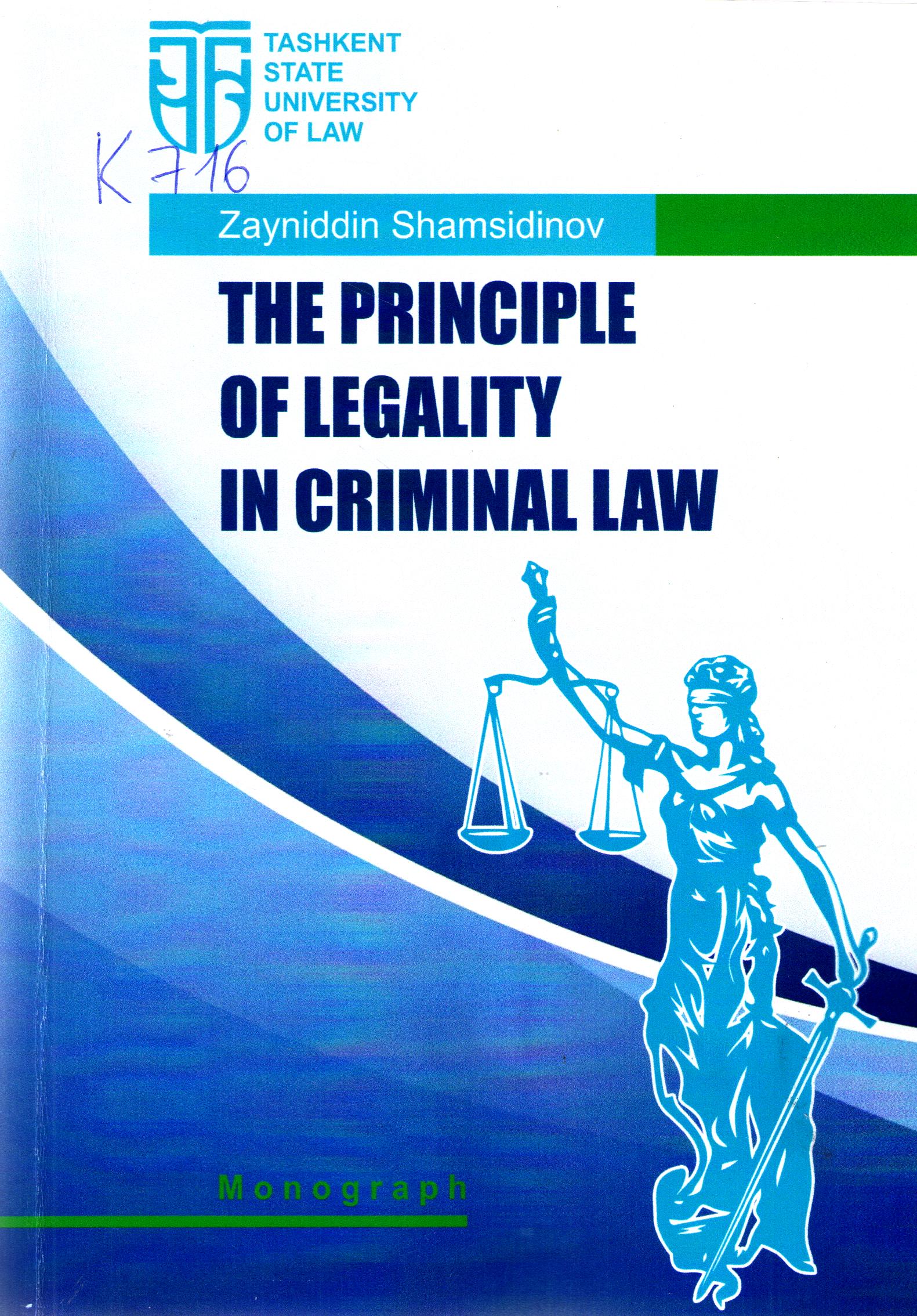
The principle of legality in criminal law
Shamsidinov Z.,This academic work offers a comprehensive analysis of the principle of legality as a foundational concept in criminal law. In the first chapter, the author examines the historical development of the legality principle, tracing its evolution from classical legal doctrines to its modern embodiment in national and international legal systems. The chapter further elaborates on the structural components and legal significance of the principle, including the requirements of clarity, non-retroactivity, and strict construction of criminal laws. The second chapter focuses on the operation of criminal law over time and in space. It discusses key issues such as the application of the criminal law to past and future acts, exceptions to the non-retroactivity rule, and the territorial, extraterritorial, and personal principles governing jurisdiction. The third chapter analyzes the sources of criminal law, emphasizing the role of statutory law, legal norms, and the necessity for consistent interpretation. The discussion concludes with an exploration of conflicts between criminal norms and methods of their resolution. This monograph is intended for researchers, academics, legal practitioners, and anyone interested in the fundamental issues of criminal law, its theoretical foundations, and practical applications. Recommended for publication by the statement of the Council of Research ethics of Tashkent State Law University No. 8 of June 20, 2025.
-

Leveraging Technology in Teaching legal English: Tools and Techniques for the ESP Classroom
Zoyirova D.,This monograph explores the incorporation of technology into the teaching of Legal English, specifically within the context of Uzbekistan, where legal professionals are increasingly required to work within international legal frameworks. The study highlights the importance of English proficiency for law students in a global legal context and examines the challenges of teaching English to this group. It builds a theoretical foundation by reviewing literature on the role of technology in language learning, particularly in legal education. Using a mixed-methods approach, the research involved 40 law students in Tashkent and combined quantitative data from questionnaires with qualitative insights from interviews and observations. Results showed positive perceptions of technology-enhanced learning, improvements in language proficiency, better legal communication skills, greater engagement, and increased learner autonomy. The study concludes that integrating technology into Legal English education has a substantial positive impact and recommends incorporating technology into curricula. It also suggests future research focus on refining effective teaching strategies for technology-driven language learning.
-

Criminal-legal characteristics of bribery: prospects for improvement based on international standards
Abzalova X.,The monograph provides a comprehensive study of bribery as the most widespread form of corruption, analyzing its historical roots, legal characteristics. and international regulation. Particular attention is paid to the evolution of anti- bribery legislation in Uzbekistan, its correlation with international standards, and comparative experience of foreign countries. The work highlights objective and subjective elements of bribery, qualifying features, and legal consequences. It also proposes directions for improving criminal legislation to enhance effectiveness of anti-corruption measures. The research is intended for scholars, legal practitioners, and policymakers concerned with criminal law and anti-corruption reforms.