
-
-
-
-
-
-
-
-
E-Learning in the 21 st Century: A Community of Inquiry Framework for Research and Practice
Garrison D. Randy,Ta'lim, -
Teaching For Quality Learning At University (Society for Research into Higher Education) 4th Edition
Biggs JohnTang Catherine,Ta'lim, -
 Ta'lim,
 -
-
-


-
-
-
-
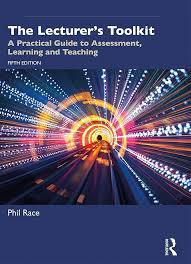
The Lecturer's Toolkit: A Practical Guide to Assessment, Learning and Teaching 5th Edition
Race Phil,The fifth edition of The Lecturer’s Toolkit addresses the needs and aspirations of all lecturers teaching in tertiary education. With a focus on practical, implementable strategies to enhance learning experiences and ensure best practice, it covers all of the need-to-know information crucial to teaching success. Pinpointing aspects of teaching excellence, the challenges and stresses of teaching and adapted to cover digital and online learning as well as face-to-face contexts, this new edition covers: designing and using learning outcomes face-to-face, online and peer dialogues using web extracts, video-clips, phones, tablets and social media in large group teaching how online learning relates to the larger contexts of lectures and MOOCs cheating, plagiarism, essay mills and online assessment
-
A Handbook for Teaching and Learning in Higher Education
Marshall Stephanie,Focused on developing professional academic skills for supporting and supervising student learning and effective teaching, the fifth edition of A Handbook for Teaching and Learning in Higher Education recognises the complex demands of teaching, research, scholarship and academic management in higher education institutions. Fully updated to reflect changes in practice and policy, this new edition has been written to enhance excellence in teaching and learning design and support all involved in facilitating a world-class inclusive education. Offering plentiful and rich practical advice, this rigorous and sound introduction to the basics of teaching and learning in higher education draws together a large number of expert authors and a range of global case studies. A definitive guide for anyone working in higher education, this edition: Offers new chapters covering an inclusive curriculum, the importance of student well-being and the scholarship of teaching and learning Considers the impact of technological changes on policy and practice Discusses the use of digital learning environments Explores how best to engage students in their disciplines and embed skills for employability The ultimate guide to support all those involved in providing student learning of the highest quality, A Handbook for Teaching and Learning in Higher Education is essential reading for all new lecturers. It will be particularly useful for anyone taking an accredited course in teaching and learning in higher education, as well as more experienced lecturers who wish to improve their teaching practice.
-
53 interesting Things to do in your Lectures
Anthony Haynes (Author),Lectures remain a staple form of teaching in higher and professional education, yet presenting doesn't come naturally to most of us. 53 Interesting Things to do in your Lectures provides practical suggestions, each tried and tested, for developing really effective lectures and presentations across all disciplines. The authors cover the full presentation process, from structuring the lecture, to use of illustrations and technology, techniques to attract and sustain student attention, active learning strategies, and dealing with questions. Whether you're new to lecturing and training and keen to develop good presentation technique, or more experienced and looking to expand your repertoire, 53 Interesting Things to do in your Lectures is a handy guide to keep on your desk.
-
E-Learning in the 21 st Century: A Community of Inquiry Framework for Research and Practice
Garrison D. Randy,The third edition of E-Learning in the 21st Century provides a coherent, comprehensive, and empirically-based framework for understanding e-learning in higher education. Garrison draws on his decades of experience and extensive research in the field to explore technological, pedagogical, and organizational implications. The third edition has been fully updated throughout and includes new material on learning technologies, MOOCs, blended learning, leadership, and the importance and role of social connections in thinking and learning, highlighting the transformative and disruptive impact that e-learning has recently had on education.
-
Teaching For Quality Learning At University (Society for Research into Higher Education) 4th Edition
Biggs JohnTang Catherine,Foreword to the first edition: "This book is an exceptional introduction to some difficult ideas. It is full of downright good advice for every academic who wants to do something practical to improve his or hers students’ learning." Paul Ramsden, Brisbane, Australia Endorsements for the fourth edition: "Biggs and Tang present a unified view of university teaching that is both grounded in research and theory and replete with guidance for novice and expert instructors. The book will inspire, challenge, unsettle, and in places annoy and even infuriate its readers, but it will succeed in helping them think about how high quality teaching can contribute to high quality learning." John Kirby, Queens University, Ontario, Canada "For those teaching in schools and universities this book provides a framework that can be used to guide teaching from thinking about what a program, topic, lesson or lecture should be about, to the execution of the teaching and reflection on the outcomes. The guiding framework emerges from a sound conceptual analysis of the how the interaction between teacher and student can be organised to result in learning that enables students to approach the levels of understanding and problem solving that we hope will emerge from our teaching." Mike Lawson, School of Education, Flinders University, Adelaide, Australia
-
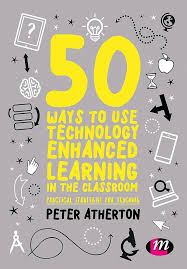
50 Ways to Use Technology Enhanced Learning in the Classroom: Practical strategies for teaching
Atherton Pete,This is a practical guide to the use of technology enhanced learning (TEL) in the classroom. Introducing 50 ways to use technology for learning. Areas covered include: - Gamified learning - Social media - Video streaming - The flipped classroom - Instant feedback tools - And many more. Guidance on how to use these technologies for learning is complemented by an exploration of their impact on learning. For each example, the opportunities for evidencing progress are evaluated.
-
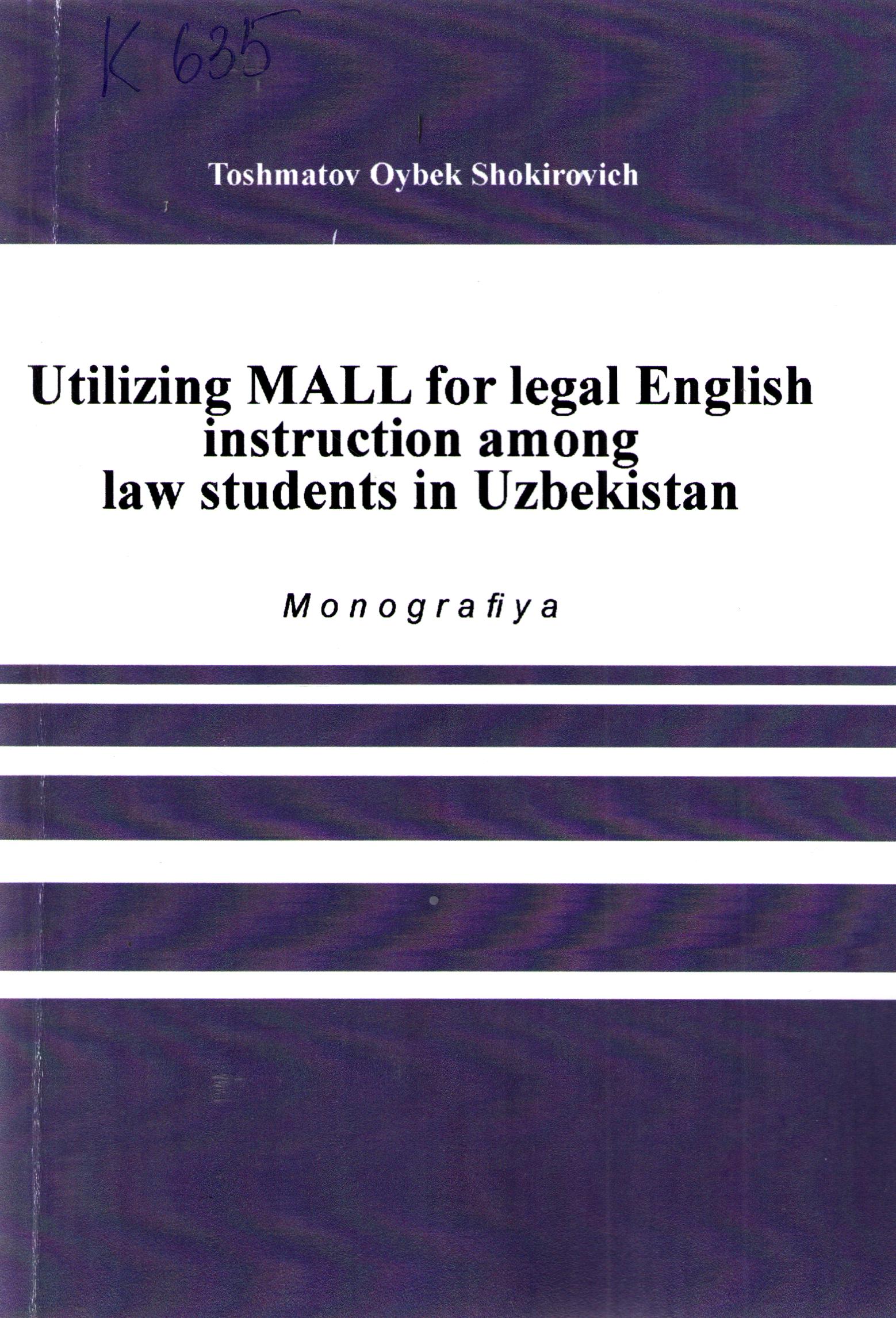
Utilizing MALL for legal English instruction among law students in Uzbekistan
Toshmatov O.Sh.,This study explores the effectiveness of Mobile-Assisted Language Learning (MALL) in enhancing Legal English proficiency among law students in Uzbekistan. Employing a mixed-methods approach, the research demonstrates that students using MALL tools show significant improvement in vocabulary acquisition, reading comprehension, and communication skills.
-

Intellectual propery and the law
Ward M.,A Guide to Intellectual property and The Law is a concise guide to the legal framework governing intellectual property. The book is comprehensive and covers all areas relating to copyright, patents etc. It will prove invaluable to all those who seek to understand more about this complex area, whether it be layperson or student. The effect of BREXIT on UK intellectual property law is discussed.
-

Privatisation of public services under gats: opportunities and challenges for developing countries
Alamonova Sh.,This monograph examines the legal and economic aspects of privatizing public services within the WTO framework. It highlights both the benefits, such as efficiency and cost savings, and the risks, including social inequality and weakened state regulation. The study also explores strategies for developing countries to navigate GATS commitments while protecting essential services.
-
-