
-
Employment Discrimination A Practical Skills Guide & Learning Lab Manual
Perdue A.L.,Employment Discrimination: A Practical Skills Guide and Learning Lab Manual prepares attorneys-inprogress to bridge the intellectual gap between substance and skill. The guide uses employment dis- crimination as a vehicle to teach students how to conduct statutory research, meaningfully engage in business development, and effectively conduct client interviews and depositions, as well as how to draft discovery requests, motions, position state- ments, and employment policies. The accompanying lab manual provides creative exercises that allow students to apply their newfound skills and knowl- edge in practical ways. Each chapter also includes thoughtful questions that promote mindfulness and reflection. Employment Discrimination can be used alone, as a supplemental text, or in conjunction with its companion text, Exploring Discrimination: Sex, Disability, and Genetic Information (2021).
-

The Brand-New Lawyer's Guide to Passing the Bar, Learning the Trade and Building a Sustainable Career
Reilly J.W.,If you're a new lawyer looking to build a successful and rewarding career, The Brand-New Lawyer's Guide is a must-read resource. It will equip you with the tools and insights needed to thrive in the legal profession, create a career you truly love, and find excitement and meaning in your work. The Brand-New Lawyer's Guide is the perfect gift for recent law grad- uates. Reilly grabs the reader's attention on page one, and he keeps it throughout. By recounting his own successes-and where he can now see that he went wrong-Reilly quickly establishes his credentials as a friend who has been there and survived to tell the tale. The friendly and nuanced advice he offers is up-to-date and spot-on. Young lawyers who read the Guide and follow its wise counsel will invariably benefit.
-
Principles of Alternative Dispute Resolution
Ware S.,Provides a clear and reliable statement of the law and concepts central to ADR (arbitration, negotiation, mediation, and other processes). Its thorough coverage of arbitration law renders this challenging and rapidly-changing body of statutes and case law accessible to the student or lawyer. The chapters on negotiation and mediation treat the subjects from the perspectives of theory, practice, and legal doctrine.
-
Mastering Trusts and Estates
Richmond G. L.,The Carolina Academic Press Mastering Series is designed to pro- vide law students the critical tools needed to easily and efficiently master the substance and content of various law school courses. All books in the series are easy to read, with key terms emphasized and explained. Footnotes and cites to secondary sources are used spar- ingly, allowing the reader to concentrate on the essential material. To facilitate the mastery of topics, the Mastering Series includes key features designed to improve learning and retention: At the beginning of each chapter, a Roadmap introduces the chapter and provides readers with an overview of the material that will be covered. This list of bulleted points clearly maps out the direction of the chapter, covering all key topics. Checkpoints at the end of each chapter encourage readers to stop and review the key concepts, reiterating what has been learned. These points serve as an excellent mecha- nism for double-checking knowledge. Finally, a Master Checklist at the end of each book rein- forces what has been covered and helps readers identify any areas that need review or further study. The Master Checklist is a perfect tool for self-assessing one's mastery of the material. Inaugurated in January 2008, the Mastering Series includes books for core, required, and other popular law school courses. For more information on available and forthcoming titles, please check out the Mastering Series on our website at www.caplaw.com.
-
-
Questions & Answers: Business Associations 3rd ed.
Branson D. M.,Each study guide in our Q&A Series contains over 150 multiple-choice and short- answer questions, as well as a comprehensive "practice final exam." to help you prepare for course study and for your final exams. Each multiple-choice question is accompanied by a detailed answer that indicates which of four options is the best answer and explains, in detail, why that option is better than the other three. Each short-answer question (designed to be answered in no more than fifteen minutes) is followed by a thoughtful, yet brief, model answer. Our growing line of Q&A titles (available in both print and eBook versions) includes the following titles:
-
Questions & Answers: Health Law
Alexander M.B.,Each study guide in our Q&A Series contains over 150 multiple-choice and short- answer questions, as well as a comprehensive "practice final exam." to help you prepare for course study and for your final exams. Each multiple-choice question is accompanied by a detailed answer that indicates which of four options is the best answer and explains, in detail, why that option is better than the other three. Each short-answer question (designed to be answered in no more than fifteen minutes) is followed by a thoughtful, yet brief, model answer. Our growing line of Q&A titles (available in both print and eBook versions) includes the following titles:
-
Questions & Answers: Administrative Law 4th ed
Jellum, L.D.,Administrative Law covers the authority and functioning of administrative agencies. It answers the following questions: Why do agencies exist? What laws regulate agency actions? How are agency personnel appointed to and removed from their positions? What actions can agencies take? What are the different types of agencies, and what are the differences among them? How does Congress delegate power to agencies? What procedures must agencies follow when they issue rules, adjudicate cases, gather information, and inspect regulated entities? What constitutional rights do those who are being regulated have? What is the appropriate relationship among courts, Congress, and agencies? When and how can entities challenge agency action? What standard of review do courts use to evaluate agency actions? The purpose of this book is to test your understanding of administrative law concepts and to assist you in preparing for a multiple choice or short-answer administrative law exam. The latest edition includes new questions and updates based on recent cases and legislation. It also includes a brief explanation of how to approach multiple choice questions. Because this book is a test tak ing aid, it is not intended to provide a comprehensive explanation of administrative law concepts. However, each question is thoroughly answered with case and statutory citations when appropri- ate. Be aware that all of the questions are hypothetical only.
-
Questions & Answers: Contracts
Burnham S.J.,Multiple-choice and short-answer questions are an excellent way to review your knowledge of the concepts of Contracts by requiring you to apply that knowledge to new fact situations. Some of the questions test your ability to recall or recognize a concept or a definition, but most of them are analytical. I believe that a good multiple-choice question is similar to an essay question and is best approached through the IRAC method. First, try to spot the issue raised by the facts. This is easier when the questions are organized by topic, for the topic will help you narrow the area from which the issue will be drawn. It will be harder in the Practice Final Exam, where the topics are interspersed.
-
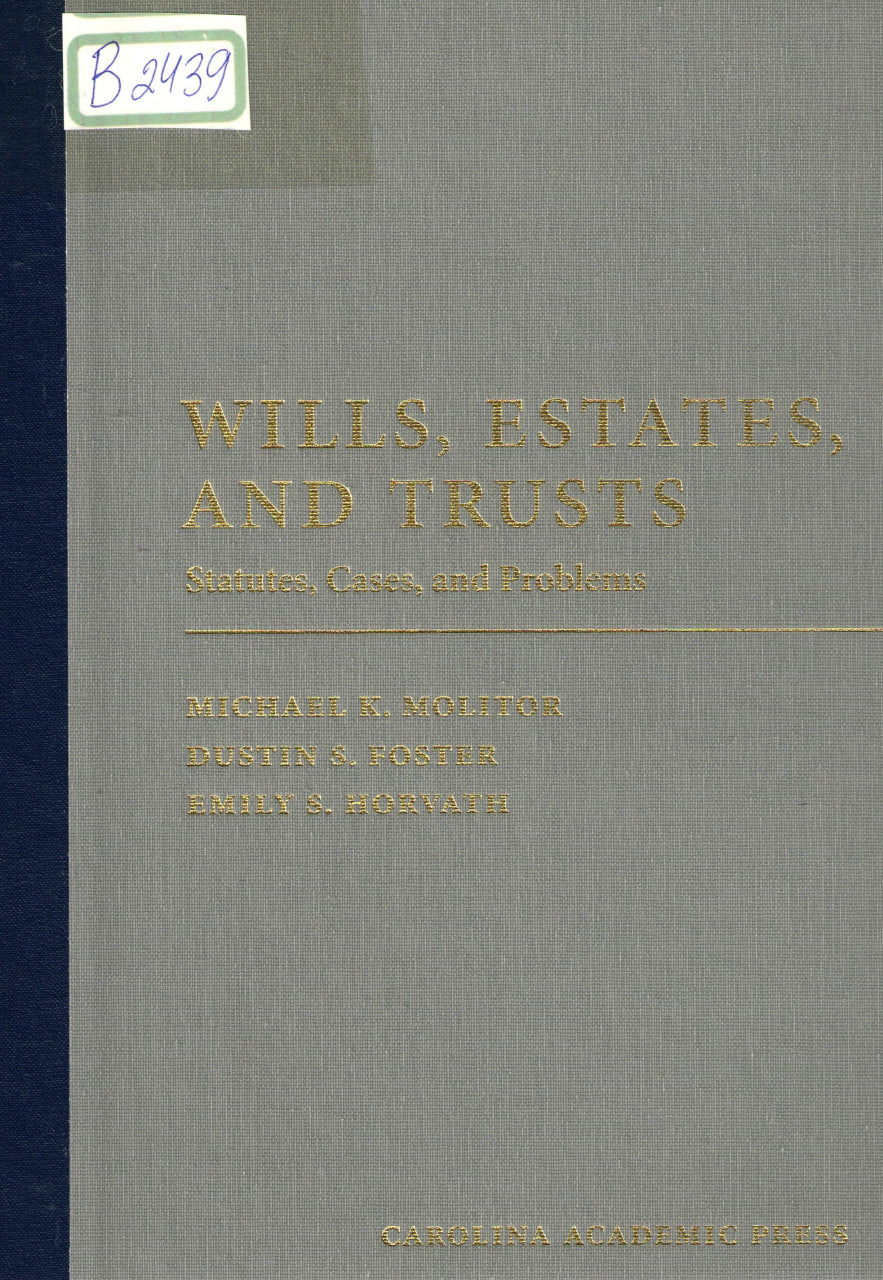
Wills, Estates, and Trusts Statutes, Cases & Problems
Molitor M.K.,Statutes. The order of items in the subtitle of this book, Statutes, Cases, and Prob- lems, was chosen for a reason: the modern law of wills, estates and trusts is largely statute-based. In researching an issue in this area of the law, lawyers almost invariably begin with the applicable statute and then look to see how courts have interpreted it. This is different from the experience that many students have in their first-year law school courses such as Torts, Criminal Law, and most notably, Constitutional Law. In those courses, cases usually are given top billing. Moreover, cases often seem more "fun" than statutes; they tell the story of a plaintiff who was (allegedly) harmed by a defendant or of a person who committed a violent crime. Supreme Court opinions interpreting the Constitution can be even more interesting; they address many issues about which people have passionate opinions, such as religion, abortion, privacy, free speech, race and gender discrimination, gun control, and governmental power. Some Supreme Court opinions rival great literature in their eloquence. By contrast, statutes seem dry, wordy, complex, and far removed from everyday experience.
-
Choice of Law An Expe-riential Learning Approach 2nd ed.
Singer J.W.,When a relationship has contacts with more than one state and those states have different laws, we face a conundrum. Which law do we apply? Some cases of this type are easy, and everyone agrees on what should be done. Of course, which cases are easy has changed dramatically over time. A case that might be thought easy in 1825 might not be thought so in 1880 or 1960 or 2020. Moreover, if it is the case that each state's law reflects policies it cares about or its sense of justice and fairness, and if each party is connected to a state that wants to protect that party, then we have a real problem. It is hard enough to decide which of several competing common law rules to adopt or statutes to enact. It is harder still when the states disagree, and they each have defen- sible reasons to govern a case that touches another state, and they each have a sense that it is only just or fair that their law apply to protect people in their state and each of the parties has a claim to the protection of their own state's law. There are many books about conflict of laws or the choice-of-law problem, and they are quite good. But there are several things missing from most books. I wrote this book for four reasons.
-
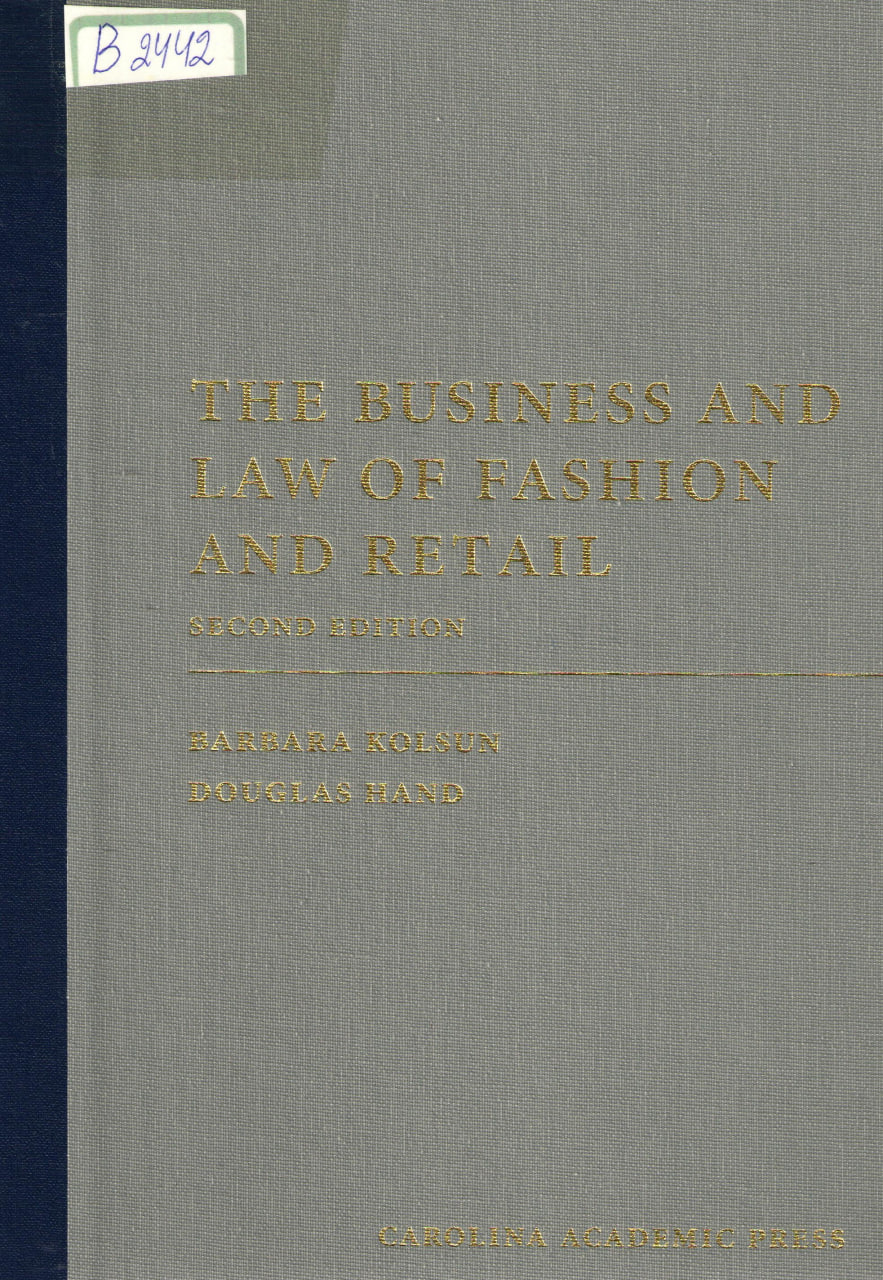
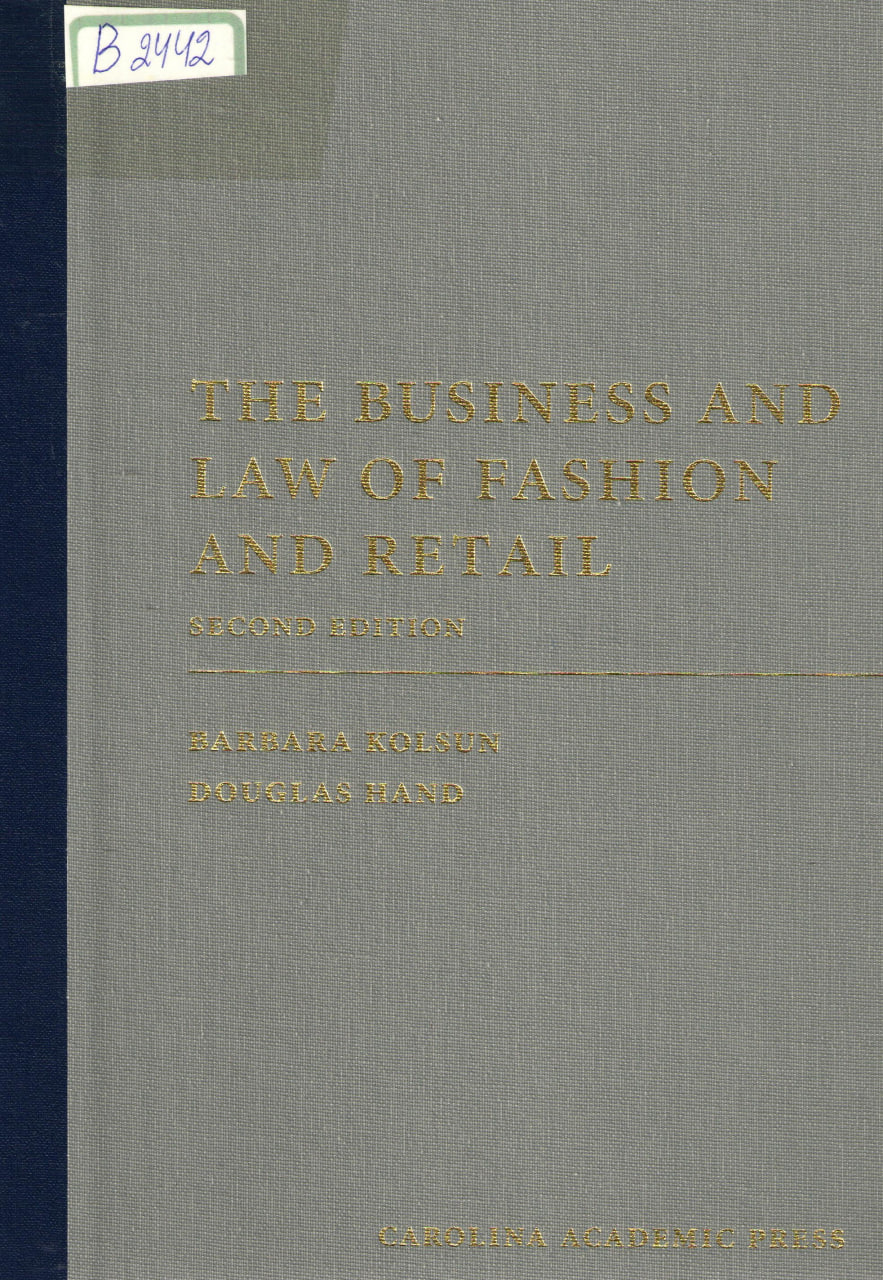
The Business and Law of Fashion and Retail 2nd ed
Kolsun B., Hand D.,Barbara Kolsun is a Professor of Practice at Cardozo School of Law, Yeshiva Uni versity, and is also the Co-Founder and Director of The FAME Center for Fashion, Arts, Media and Entertainment Law at Cardozo School of Law, the first law school program providing training and development opportunities relating to the repre- sentation of businesses driven by the creative process. She has been a leading fash- ion industry attorney for 35 years and was also co-editor of the first handbook on Fashion Law, Fashion Law: A Guide for Designers, Fashion Executives and Attorneys (Bloomsbury, 2010, 2014), the first casebook on Fashion Law, Fashion Law: Cases and Materials (Carolina Academic Press, 2016), and The Business and Law of Fashion and Retail (Carolina Academic Press, 2020). She developed the first joint JD/MBA course in Fashion Law and Business at New York University and has also taught at Fordham Law School and guest lectured at dozens of law schools and fashion schools. She started the legal departments at three "startups"-Kate Spade, Seven for All Mankind and Stuart Weitzman and was the first General Counsel at all three companies. She was Assistant GC at Calvin Klein Jeans and Westpoint Stevens and has probably been through more mergers than most lawyers in the fashion business. While in private practice, her clients included Tommy Hilfiger and Ralph Lauren. and she also consulted with fashion companies including Sam Edelman and New York & Company on various issues. She has chaired and been a regular speaker at the Luxury Law Summit in New York and London for several years. She has been honored with lifetime achievement awards in 2015 by the Luxury Summit and the World Trademark Forum, and another lifetime achievement award from the Women in Law Empowerment Forum. She has also served as Chairman of the Board of the International Anticounterfeiting Coalition and has spoken and published widely on fashion law around the world.
-
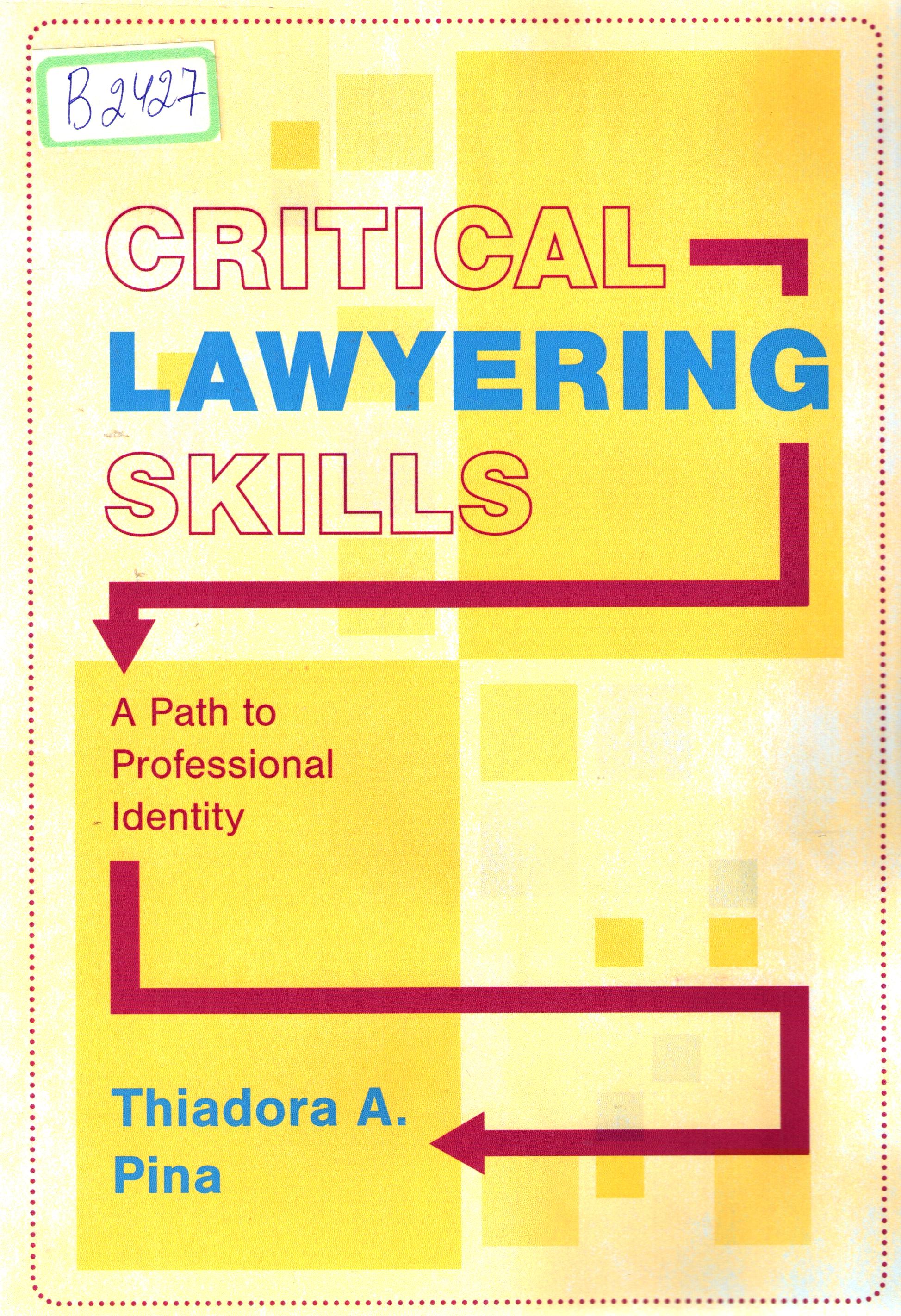
Critical Lawyering Skills A Path to Profes-nal Identity
Pina T.,Developing a strong professional identity is crucial for success in the legal field. To help law students navigate this process effectively, Critical Lawyering Skills: A Path to Professional Identity provides practical tools and exercises. This workbook aligns with ABA Standards 303(b)(3) and (c), including addressing well-being and social (cultural) competence, and features learning objectives, rubrics, and assessment tools. The workbook format enables students to practice these skills rather than simply reading about them. By engaging with the book's material, law students will gain clearer perspective on the role of a lawyer and the responsibilities that come with it, which will serve them well as they transition from law students to practicing attorneys.
-
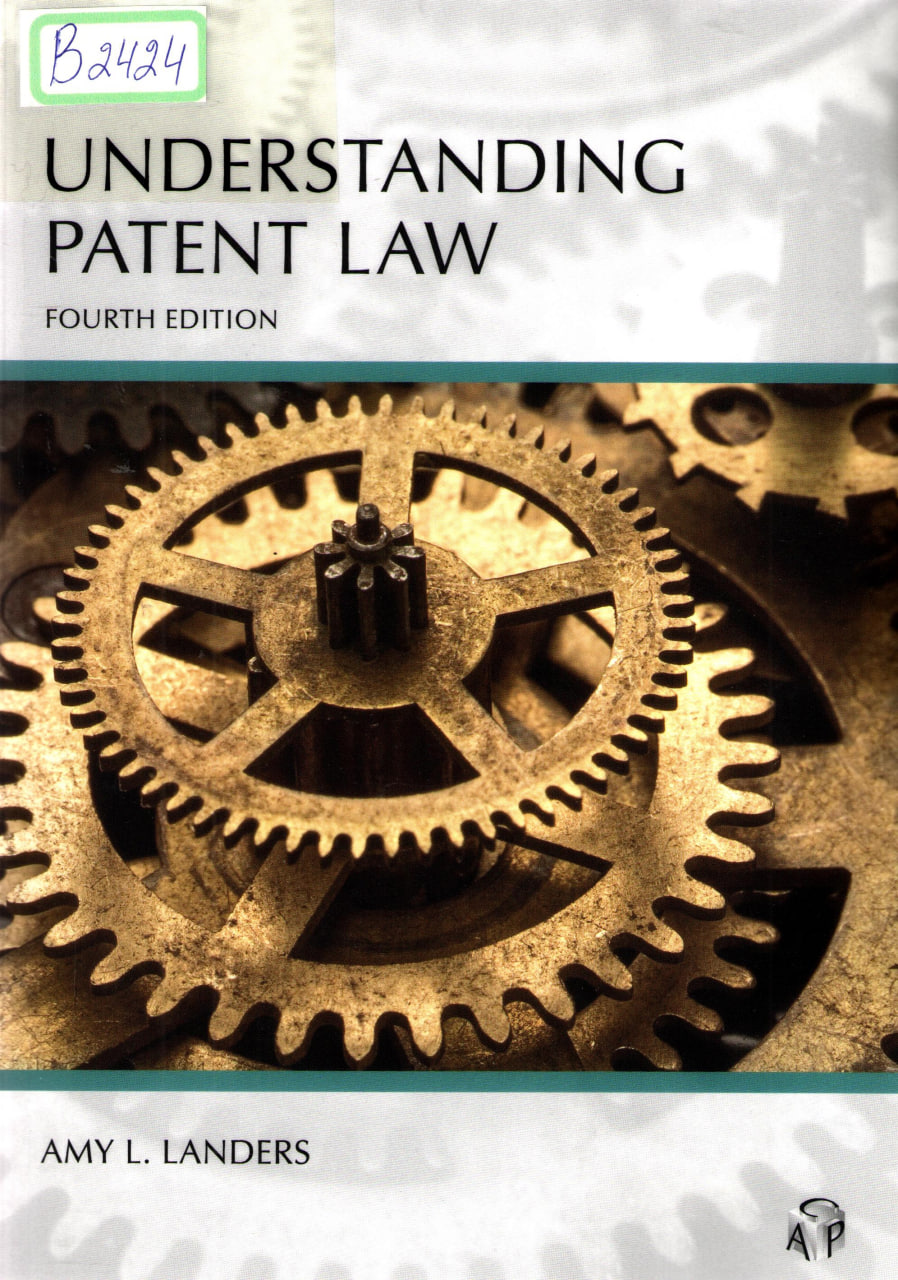
Understanding Patent Law 4th ed.
Landers A.L.,Patent law is an important, fascinating, and rapidly changing field. This book was written for all who need to understand these recent changes, as well as for students in intellectual property courses. For those engaged in international practice, this work sheds helpful light on the key doctrines and theories underlying U.S. patent law. More examples and explanatory material, as well as flow charts, have been included in this edition to provide some practical application of abstract or difficult concepts. The most significant areas of updated materials include the rapidly evolving law concerning statutory subject matter, nonobviousness, and the application of the America Invents Act. This work covers the latest U.S. Supreme Court decisions, including SAS Institute v. Iancu, Oil States Energy Services v. Greene's Energy Group, Helsinn Healthcare v. Teva Pharmaceuticals USA, and WesternGeco v. ION Geophysical Corporation. The book also covers the major decisions of the U.S. Court of Appeals for the Federal Circuit. Each chapter has been comprehensively updated to reflect those decisions that refine, explain, or modify the existing state of patent law. The Federal Circuit's Thaler opinion regarding artificial intelligence exclusion from inventorship is explained, the World Trade Organization's consideration of the treatment of intellectual property for the COVID-19 vaccines is discussed, and material that explains the European Union's Unitary Patent System has been added to provide real-world examples of the concepts covered in the fourth edition.
-
Personal Property Law 4th ed.
Bridge M.,What type of right is a property right? How are items of property classified for legal purposes? In this revised edition of Personal Property Law, Michael Bridge provides answers to these fundamental questions of property law. His critical analysis includes new material on a variety of subjects, including tracing, knowing receipt, and wrongful assistance, as well as copious references to recent case law (eg, OBG v Allan, Yearworth, Your Response, Belmont) and statutory developments. Widely considered to be the best short introduction to English personal property law, Bridge constructs an authoritative and systematic summary of this complex field for readers approaching the subject for the first time. It focuses on the acquisition, loss, transfer, and protection of interests in personal property law, and specific topics include: ownership and possession; treatment of the separate contributions of the common law and equity to modern personal property law; discussion of modes of transfer; the means of protecting property interests; the resolution of disputes concerning title to personal property; the grant of security interests, and the issues arising out of the transformation and mixing of tangible personal property. Michael Bridge is the Cassel Professor of Commercial Law at the London School of Economics and Professor Law, National University of Singapore.
-
MAstering Trademark and Unfair Competition Law 2nd ed.
Smith L.S., Gibbons L.J.,The Carolina Academic Press Mastering Series is designed to provide law students the critical tools needed to easily and efficiently master the substance and content of various law school courses. All books in the series are easy to read, with key terms emphasized and explained. Footnotes and cites to secondary sources are used sparingly, allowing the reader to concentrate on the essential material. To facilitate the mastery of topics, the Mastering Series includes key features designed to improve learning and retention: At the beginning of each chapter, a Roadmap introduces the chapter and provides readers with an overview of the material that will be covered. This list of bulleted points clearly maps out the direction of the chapter, covering all key topics. Checkpoints at the end of each chapter encourage readers to stop and review the key concepts, reiterating what has been learned. These points serve as an excellent mechanism for double-checking knowledge. Finally, a Master Checklist at the end of each book rein- forces what has been covered and helps readers identify any areas that need review or further study. The Master Checklist is a perfect tool for self-assessing one's mastery of the material. Inaugurated in January 2008, the Mastering Series includes books for core, required, and other popular law school courses. For more information on available and forthcoming titles, please check out the Mastering Series on our website at www.caplaw.com.
-
National Security Law: An Introduction
Forehand J.D.,Written by a practitioner with more than 25 years of experience in the field and accessible to a non-legal audience, this book delivers a comprehensive and easy-to-follow legal and historical survey of the use of national security power by the United States government. It is an essential resource for government leaders, military officers, national security employees, policymakers, students, and concerned citizens. Topics include separation of powers, authorizations for war, domestic military use, the Fourth Amendment, FISA, warrantless surveillance, covert action, internal security, border security, counterterrorism, classified information, protection of advanced technology, and much more. A must-read for anyone who is curious about the legal complexities surrounding the topic of national security.
-
Evidence
Friedman R.D.,Elgar Advanced Introductions are stimulating and thoughtful intro- ductions to major fields in the social sciences, business and law, expertly written by the world's leading scholars. Designed to be accessible yet rig- orous, they offer concise and lucid surveys of the substantive and policy issues associated with discrete subject areas. The aims of the series are two-fold: to pinpoint essential principles of a particular field, and to offer insights that stimulate critical thinking. By distilling the vast and often technical corpus of information on the subject into a concise and meaningful form, the books serve as accessible intro- ductions for undergraduate and graduate students coming to the subject for the first time. Importantly, they also develop well-informed, nuanced critiques of the field that will challenge and extend the understanding of advanced students, scholars and policy-makers. For a full list of titles in the series please see the back of the book. This is also available on https://www.elgaronline.com/ and https://www advancedintros.com/for Elgar Advanced Introduction in Law.
-
Advanced Introduction to Corporate Governance Law and regulation
ChEFfins B.R.,Elgar Advanced Introductions are stimulating and thoughtful intro- ductions to major fields in the social sciences, business and law, expertly written by the world's leading scholars. Designed to be accessible yet rig- orous, they offer concise and lucid surveys of the substantive and policy issues associated with discrete subject areas. The aims of the series are two-fold: to pinpoint essential principles of a particular field, and to offer insights that stimulate critical thinking. By distilling the vast and often technical corpus of information on the subject into a concise and meaningful form, the books serve as accessible intro- ductions for undergraduate and graduate students coming to the subject for the first time. Importantly, they also develop well-informed, nuanced critiques of the field that will challenge and extend the understanding of advanced students, scholars and policy-makers. For a full list of titles in the series please see the back of the book. This is also available on https://www.elgaronline.com/ and https://www advancedintros.com/ for Elgar Advanced Introduction in Law.
-
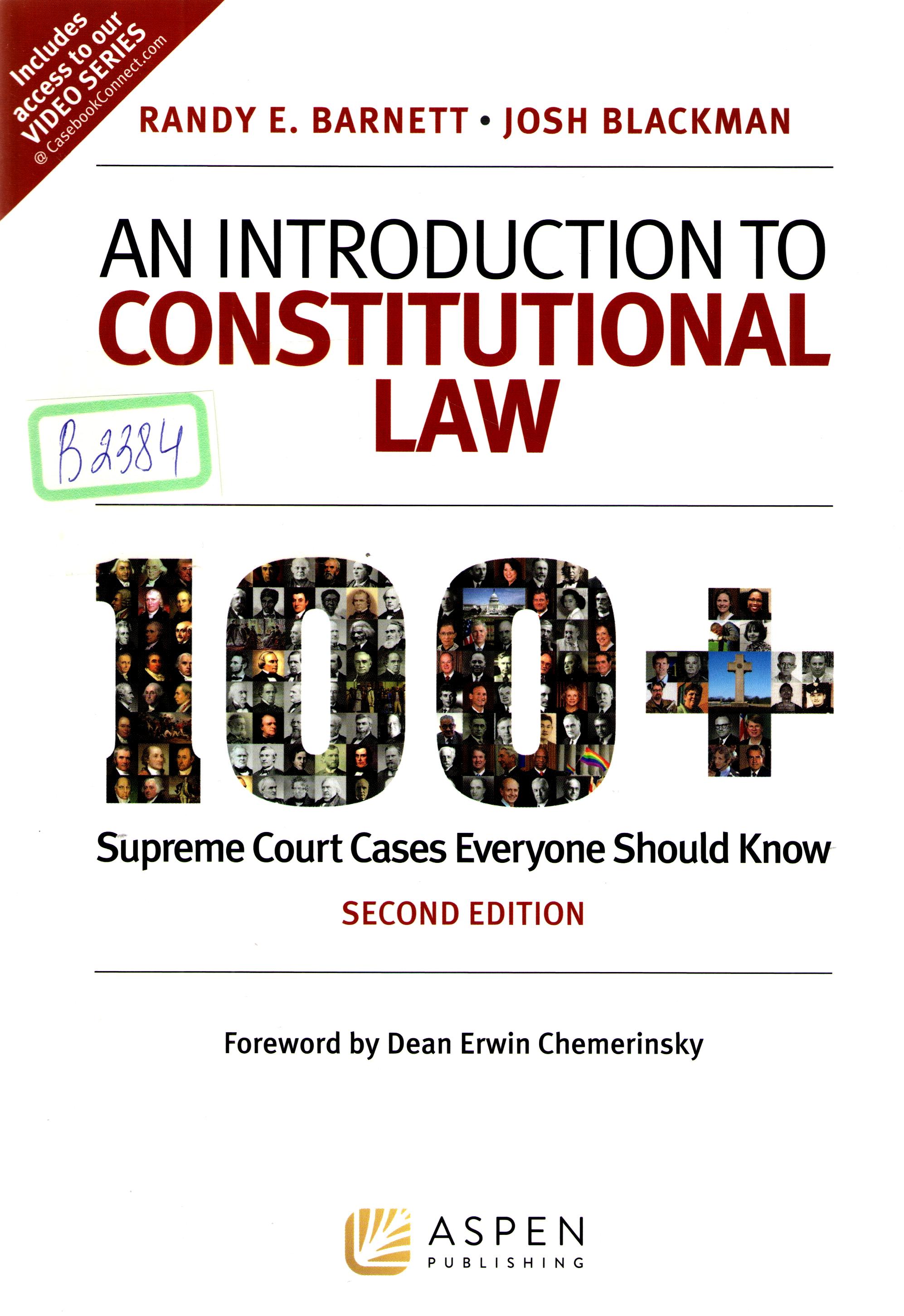
An Introduction to Constitutional Law
Barnett R. E., Blackman J.,This multimedia platform has innovated how constitutional law is studied: incisive and balanced summaries of landmark decisions, written by leading constitutional law scholars, combined with an engaging video library, in an affordable paperback edition. An Introduction to Constitutional Law has been read by tens of thousands of students in law schools, universities, high schools, and homeschools, as well as by people with a general interest in the Supreme Court. An Introduction to Constitutional Law will teach you the narrative of constitutional law as it has developed over the past two centuries. The online video library will bring to life the Supreme Court's 100+ most important decisions. The videos are enriched by photographs, maps, and even audio from the Supreme Court. The Second Edition includes recent Supreme Court cases on abortion, the Second Amendment, and the Free Exercise of Religion, as well as some classic cases on the Freedom of Speech, Criminal Procedure, and Voting Rights. All students-even those unfamiliar with American history-will learn the essential background information to grasp how this body of law has come to be what it is today.